Be yourself; Everyone else is already taken.
— Oscar Wilde.
This is the first post on my new blog. I’m just getting this new blog going, so stay tuned for more. Subscribe below to get notified when I post new updates.
Be yourself; Everyone else is already taken.
— Oscar Wilde.
This is the first post on my new blog. I’m just getting this new blog going, so stay tuned for more. Subscribe below to get notified when I post new updates.
There have been so many lessons I have learned throughout the year since taking this course on writing. One thing I continue to tell myself, though, is that it’s always important to learn new methods, which then motivate you to become better in whatever you’re doing, and in our case, writing. Having observed from many teachers in middle school so far, I have had the pleasure to ask them a lot of questions, and I have been thankful for their advice. I will be observing high school in the fall, a time that will, no doubt, be different, as kids will most likely arrive back in the classrooms to learn, but doing so under many different conditions, I’d assume, that we have never seen before. It’ll be a different time for everybody, but I look forward to the things I have learned and will learn going forward.
The first question I’d have to ask middle and high school teachers is how they convince their students that writing is important, not just in writing, but across all content areas and disciplines. After observing in middle school classrooms last spring, I saw so many students, when told to begin writing in their notebooks, sit there with no drive or motivation to put anything on the page. I sat there carefully jotting notes down in my notebook as my eyes wandered around the room, waiting for the teacher(s) to notice and then head over there to give them a nudge. Convincing young students that writing benefits you as much as anything else after school is tough because they’re young and don’t realize it yet.

Do you incorporate enough ‘authentic writing’ in your classroom? A lot of teachers in middle school and high school enforce curriculum’s that revolve around test preparation, whether it be in-classroom testing or state testing. Not enough time goes into preparing students to write for authentic audiences and voices. Why do we think a lot of students scoff at the idea of writing? Starting them at a young age is the best way to train them so that when they get to high school, they already have a clear understanding of how to write across different disciplines and content areas for various audiences. Learning how to write to specific audiences will help you, say, for example, write a future police report, movie review, sports event recap, even a mathematical report. Writing is necessary for all disciplines, so teaching them the correct and proper way to write is imperative to their success and development.
So, as I finish up my final blog in Professor Lindblom’s WRT 392 class, I have learned tons of new exercises and motivating tactics that I’m excited to use when I observe high school in the fall, and eventually, student teaching in the spring. I have learned many lessons I will carry with me for many years to come, and I want to thank him for introducing me to many of them, whether it be in his book Continuing the Journey 2 or in class.
This semester has been…chaotic, to say the least. However, along the way, I have been privileged to have learned some fantastic ideas, concepts, and truths from some of the best educators in the world. From Leila Christenbury to my professor, Mr. Kenneth Lindblom, Jim Burke, and the many others encountered in the “Teacher’s Lounge,” thank you. Your innovative practices will be implemented at some point in time inside my classroom. While observing the many intellects, I started to think to myself: what is my eventual philosophy for a growing classroom? This was something I had been curious about before the semester had even begun, so for me, I wanted to go into these next few months prioritizing my eventual template for how I want my students to learn writing inside my classroom. The idea is to create a necessary balance of exercises that foster development for the year. I want my students to know that their writing is unique, and how they get from point A to point B is a process, one that they can call their own, and nobody is to tell them it is incorrect.
Anytime we sit down and put pen to paper or fingers to keys, we need to ask ourselves one question: what message or point are we trying to convey to our audience? Jim Burke in his The Six Academic Writing Assignments: Designing the Users Journey, discusses self-evaluation, and why the student needs to evaluate their written progress throughout their time spent in the classroom. When in class, you expect to grasp new tools and to be able to effectively use them in your writing. I discussed this in a blog post of my own, but the idea of having peers review my writing to check for mistakes, improper sentences or even to find ways to enhance the content never crossed my mind. I should also note that this was mostly during my middle and high school days. It became a goal of mine to sit down and finish papers as quickly as possible, but maybe not as efficiently. What was the purpose of me being so eager to finish the paper in record speeds? I simply didn’t enjoy a lot of the predetermined topics and narrow choices that had been selected for me by the teachers. It was hard for me to engage with the content because I didn’t enjoy what I was writing about. Simply, it just didn’t serve a purpose for me. Me being the naive student I was felt that I knew more about what I wanted to say than somebody else so why would I listen to someone else’s thoughts or suggestions? After all, they didn’t know what I was trying to convey. Sure, I’d listen to the teacher, but that’s as far as I’d go for feedback on my writing. It wasn’t until I arrived at Suffolk County Community College for writing classes that I learned how imperative it was to bounce ideas off your peers and to brainstorm ideas, thoughts, and concepts as a unit. Burke also discusses the idea of structured note-taking, which allows the student to organize their thoughts and ideas in a more coherently. Taking notes on post-its when reading books was always something I did, as it usually helped me remember certain events necessary for when I had to write a paper on the book or take a quiz/test. Noah discusses the idea of annotating works of literature and it ties in nicely to what is being discussed here with note-taking. Noah goes on to say, “I never really liked annotating when I was in school, I always felt like it took away the magic of reading. I was being ripped out of my exciting book for of mystery and magic, to underline a comment about personification… how lame is that?” Well, he isn’t entirely wrong. I always found it hard to enjoy a book if I was required to annotate every few pages, cherry-picking for literary devices to tie back into my book. I like how Noah talks about the double-edged sword that comes with annotating. Sure, it’s helpful, but you can’t abuse its meaning. Teachers that force students to constantly annotate everything they read will wonder why the student has a hard time engaging and making sense of the story itself. This is why balance is key.

Ah, yes, the progress journals. Journaling was always something I looked forward to, especially in middle school. The idea of having the class quiet down and ideas to freely flow through my head was appealing to me. I enjoyed thinking about what I was going to write next. Something to note about the progress journals: in Burke’s The Six Academic Writing Assignments: Designing the Users Journey, he talks about how important it is for students to “reflect on their progress,… demonstrate their understanding through informational assignments such as exit tickets; or write in their notebooks… [relating] to what we are reading, discussing, or learning” (Burke 14-15). I know Rhiannon discussed the progress journals in her blog, as well. I like this idea because it allows the students to track their progress over time. Now, when journaling, you can have the students divide the notebook into genres or topics to write about. As they flashback to these pieces over time, they’ll be able to see how much they have gained from this exercise. Doing this allows one to track their punctuation, grammar, ideas, world flow, etc. These notebooks are of good use to the student and will only produce positive results. There is no reason not to incorporate some sort of journaling inside the classroom. Allowing students to develop their ideas of what they want to write about allows them to become more motivated writers. With the journals, the student can see their path from start to finish. Everybody has their unique path, and it would be pretty cool if a student can see how they exactly got to the finish line. The journals allow students to understand that past mistakes and bad habits are breakable and acceptable, as long as you show you’ve learned from them. Here’s a secret regarding the progress journals: they’re universal! People write their ideas down all the time, no matter the content background they’re in. Math, English, History, Science, etc, it works.
I cannot stress this enough: authentic writing is essential to classrooms, especially in the year 2020. Over time, too much of the focus has gone to preparing students for tests. Not enough time and effort has gone into preparing students for writing to real-life audiences for an intended purpose and that has to change. Authentic writing is purposeful when writing to specific target audiences. Maybe it’s my poor memory, but the only time I ever remember writing to an actual person or audience was when I wrote to my penpal in elementary school. We exchanged letters and eventually met, this per the school’s curricular requirements. Professor Lindblom has a quote in his Continuing the Journey 2, and it reads like this, “authentic writing instruction is an advanced approach to teaching, and one that we believe should be used with students of all ages and abilities. Bringing student writers into the real world of writing creates greatly enhanced opportunities and can truly set fire to students’ engagement, creativity, and empowerment” (Lindblom 53). This quote was powerful, and it was one that I made sure to immediately place into my outline before I began typing this post. I believe that allowing a student’s work to be published for a real audience for real people will thus cause more motivated students. There is no doubt that this also forces students to articulate their thoughts and ideas to those outside their specific disciplines of study. Authentic writing also allows for more organic class discussions, more participants, and even potential consequences. Now, I know “consequences” will raise the ears a bit, but bear with me: if we don’t allow real-life discussions to occur inside the classroom, what are we teaching our students? To avoid any type of uncomfortable real-world problem or topics they’ll ever face, thus shielding them for all things unholy? Sure, topics can get sensitive, which is why it’s up to the student if they choose to become a participant or not. This is where having a respectable educator leading the room plays a significant role. On a personal note, I have written more than a few articles for publications such as The Hockey Writers and ET Week media, and I can say that it’s always satisfying to get feedback on your thoughts and ideas and to engage with others about them. It’s rewarding. These are many of the necessary exercises I will bring into my classroom that I feel will have a lasting impact on the young minds that I plan to mold in their pursuits to become better, more efficient writers.
In order to teach students to be real writers, the teacher has to treat them as if they are one. Giving students assignments that lack purpose and detail is only going to steer them away from the goal and enhance their lack of motivation. Too often have we relied on state testing and inauthentic writing assignments to convey messages and meanings to our students. By doing this, are we preparing them to write for real-life audiences? And not only this but are we developing them to write for other disciplines, as well? It’s a legitimate question and concern I have because I was one of these students who did not get to write for authentic audiences throughout middle school and high school. I had to write for outside publications, to audiences I was specifically targeting, sports, my specialty. Now, the major question that presents itself is this: after reading all semester about concepts and strategies to motivate young students to become solid writers, how can we get them to feel, think and talk like real writers?
This is something I observed and took part in myself when I was in middle school last spring. I observed a former teacher of mine, and I was surprised that she still had them doing free-writing for 15 minutes, anything they chose to write about in their notebooks. I liked it, and I thought it was a great way to stimulate the brain and its thoughts. The idea of having them sit down, write out what they feel is important to them based on that day, is a way to convey your message to them: that writing can be fun and interesting. I remember, on a personal note, when I was in this specific teacher’s class, I used to be so relaxed and excited to write about something that interested me while the room remained quiet. That’s the best type of atmosphere when everybody’s thoughts and ideas are considered acceptable. Some teachers use specific exercises or practices to move into a topic or lesson, but this is a simple one that should be emphasized more often in classrooms.
Now, we covered in detail what authentic writing is. Classroom discussions that engage the entire room foster development. They move the room forward, cause others to respect others’ opinions, and they also provide each and every student with a voice that they know they can share. I know from our class experience, I enjoyed the various voices and discussions everybody shared. Their opinions were their opinions, and it was always interesting to see and understand where they were coming from. A lot of times I found myself comprehending something differently after I heard students touch on topics or points. It got me thinking a different way, and it gave me different outlooks. With authentic writing assignments, we’re writing to real audiences for a real purpose. With authentic conversations, I feel like we can touch on even the most sensitive topics while still hearing what our colleagues have to say about those very same topics. We have to be respectful of others’ opinions, it’s critical to a successful learning environment. If everybody has respect for one another’s opinions, you’ll have a fun, interacting, and engaging learning experience.

This is an exercise that most teachers use, but do they do it the correct way? Do they stress it enough? In classrooms, we write papers and we sometimes hand them in without revising them thoroughly. Throughout middle school and high school, I was forced to write so many papers about books that didn’t interest me that I’d write them as quickly as possible and hand them in so that I wouldn’t have to worry about it going forward. The grades were decent, but like everything in life, it could’ve been better. Once I got to Suffolk County Community College, I started taking writing classes that stressed peer-review. It was every single paper that we wrote we had to exchange with one or two students so that they can give us helpful feedback. I wish I would’ve done this earlier, but better late than never. When you use peers for feedback, you’re using their thoughts and ideas combined with your own to form the best product possible on the page or screen. Brainstorming with others is a great way to open your mind to other avenues, possibilities, and opinions. There is really no negative to peer-review, as long as the person responsible for your paper is putting in the work to provide you with helpful feedback, everybody benefits.
It was discussed in Jim Burke’s The Six Academic Writing Assignments and Rhiannon discussed it in her last blog, but a teacher took his class outside before they started a novel, and he lined them up on the football field on the yard-line by age. It was an interesting exercise, to say the least. I met with a man over the summer named Dr. Michael J. Hynes, who happens to be the Chief of Port Washington schools, and he told me and Sean (McDonough) that he found it helpful to have students do quick exercise before starting the class up. For example, jumping jacks for 30-45 seconds to get the blood flowing and brain stimulated. Their studies showed increased learning and better results. I came away from that meeting impressed by his innovative practices he discussed and it’s no surprise as to why he was sought after by other schools. I actually am leaning towards incorporating this into my classroom, especially after it checked out and proved to have worked for many students.

I discussed peer-review and stressed the importance of it, but when it comes time to write a paper, I want to either work collaboratively as a class or put my students into small groups to brainstorm ideas and topics, while exchanging thoughts and suggestions. Papers are stressful, and they can be overwhelming for many, but what if we took some of that pressure off the student by allowing them to meet with others to discuss topics and ideas for their paper? A lot of times teachers hand out assignments and the student has to generate ideas by themselves and often struggle. The teacher is there for suggestions but they’re not going to walk you through your paper or hold your hand. Students, our friends, the ones that care, will help us through the process. Imagine, for example, the teacher is working the Sci-Fi unit, and they tell you the entire class will be writing about space travel. It’s a vague topic, but it’s one that you can do a lot with. Having a discussion with others about a topic as interesting as this would be incredible, and I’d be surprised to find any student that wasn’t excited or in favor of partaking in this exercise.
After having some time on my hands to analyze some of Jim Burke’s thoughts, ideas and concepts, it is quite clear why he’s one of the most smartest teaching figures out there. Jim Burke’s The Six Academic Writing Assignments: Designing the Users Journey does an extremely effective job at churning out enough content to fuel a student’s passion and drive to succeed in becoming an effective and efficient writer. It’s not always about being a good writer, but if we can motivate students to want to write more, that in itself is a major way to stimulate their drive to improve and better themselves to become better learners, as well. So, without further adieu, let’s dig into some of what Burke highlights in his famous guide to becoming a better and more motivated writer.
We immediately open Burke’s instructional guide to a topic that gets the conversation about writing going. “Writing to Learn” is extremely necessary and must be something that one can grasp before they really start putting pen to paper or fingers to keys. If you don’t have a goal in mind or reason to learn from your writing, you’re clearly doing it wrong. Now, personally, I write and always feel I have something to learn and appreciate helpful feedback. All throughout middle school and high school I’d write papers as fast as can be and hand them in as soon as possible. I hated to delay the process and procrastinate, so I’d sit there, hours at a time, and hammer away at the keys, trying so desperately to finish the assignment so that I could put it in my rear-view mirror. However, what I wasn’t doing was listening to enough feedback from my peers. I never had put much stock into what another student thought about my writing and maybe it was because I was still immature and naive in a way. I always figured that they had their piece they wanted to articulate and I had mine, and that nobody should be trying to change what I had written. Narrow-minded, eh? Once I got to college, Suffolk County Community College, I began to use peer reviews for ideas, grammatical errors, etc. Before I handed in a paper, it was going to reach the hands of at least one other student and the teacher, and if not the latter, I’d give it to two students to look over. I continued this when I got to Stony Brook and continue to do it for final papers. I want feedback, I want to learn from my mistakes or ways I can improve what is already put on the virtual screen or paper.

An idea that I’m seeing more and more teachers discuss is the thought of having students keep logs about the progress they’re making with writing inside the classroom. The idea is beneficial to helping a student see his/her progress taken over the course of the year. I don’t know about anybody else but I always thought it was cool to reflect on stuff I had written months in advance or even years in advance. To this day, I still find some of my writing notebooks downstairs and flip through the pages remembering what it was like to sit in a second-grade classroom and talk about my Sunday soccer game and the snack I had after the game (haha). But with writing, it’s important to demonstrate some sort of understanding from past mistakes and bad habits. There is so much to learn in life and the same goes for writing in any discipline. Grammatical mistakes, the improvement in that area over the course of a grade year, the punctuation errors, etc, all of this is something I analyze as I’m flipping through the pages. Now, Burke had his students take part in an interesting group assignment: he decided to take his students outside onto the football field, as Rhiannon mentions in her blog, and had them stand on a yard line according to age. This was a way to stimulate their brains for the eventual beginning of the novel Into the Wild by Jon Krakauer. Taking your students and placing them into a different, unfamiliar territory or enviornment can open up an entire new world to them and how they approach writing. As far as my own experiences, I went outside the Humanities building to write in a class on a beautiful 70 degree afternoon one late afternoon almost a year ago, and it was the best experience ever: sitting outside, enjoying the sun and writing. It wasn’t something I would’ve typically done, but it was different and enjoyable.
School isn’t just to test a child’s knowledge or the growth they’re making throughout the course year, but it’s also a moment to find out how much the teacher is progressing, as well. Teachers that recycle the same material for a decade and are set in their ways will find it challenging to adjust to different students. Our generation is different than others: as we spend a majority of our time learning electronically. The days of scouring through textbooks, physically at least, seem to be dwindling. It is important for teachers to demonstrate progress and mature as an educator of bright, youthful minded learners. As Sean discusses in his blog, that teachers should reflect on the type of assignments they have given. Have they given an exercise that has been enforced a tad too much over the course of the year? Have they neglected to teach students enough about research papers and why they’re important? Hopefully they haven’t. This is why I only see it as a benefit to mark up a checklist of sorts so that each exercise is covered and touched up on with as much time given to it as possible over the course of the school year. As Sean said, putting together lesson plans can be challenging, and so far, I have only experienced this with Methods I under Professor Thomas Mangano’s leadership, guidance and instruction. Allowing yourself, as the teacher, to become redundant, causes further stagnation with both yourself and the crop of students. Having a balanced diet of instruction and writing creates an organic classroom environment and allows everybody’s thoughts and ideas to flow better, thus making it rewarding to participate on the daily.
In the book Continuing the Journey 2 by Ken Lindblom and Leila Christenbury, both state the following about authentic writing assignments, “students write to a real audience for a real purpose in a real forum” (Lindbolm 33). With an assignment like this, it is the students who have the say in what they write. Not only do they have a say in what they write, but they also get feedback from specific interest groups, those that the student is writing for. Here’s the issue, however, there are still many teachers that are pushing students to read and write a certain way, a dry way, as I like to call it. When you tell your students, as the teacher, to use an outline, brainstorm, and write using a specific prompt, you’re forcing them to do it in a way that may not work for them. It also pushes young writers away.
This is a writing exercise I learned from my friend John. An avid writer himself, he told me that he and his friend usually write down three things of interest down on a piece of paper, and then when they’re done, they each pick one topic off the other person’s list that they’d want to write about. It’s a great idea and one I needed to include in here. It’s such a great idea that I’ve already started to think about ways to include it in my future classroom. With this exercise, the students are demonstrating authentic writing because the topics they chose came off of their friend’s list, so the topic has interest to both.

With authentic genre, the days of students, well, students were never too enamored with the idea of writing boring five-paragraph essays about topics or things irrelevant to daily life. I can tell you this, though, students would be eager to write a paper around a vacation they just took to Disney World, or even a paper about their last soccer tournament and how it played out and impacted them. Writing authentic genres or topics that impact or pertain to a person’s life is a great way to engage young students with the idea of writing. What student wants to give you an essay based around a boring topic that has nothing to do with their life in any way, and probably will never matter to them the second they hand it in? Nobody, and that’s a fact. But, what if we told our students they could write about a book that impacted their life in some sort of way and why? Now that’s a story I’d want to read from my student. In Anne Elrod Whitney’s “Keeping It Real: Valuing Authenticity In the Writing Classroom,” she mentions the idea of authentic genre, and then she goes on to mention the things she has her students do.
Yes, writing isn’t easy. Students need to know that even the best writers in the world have struggled and continue to struggle when putting pen to paper or fingers to keys. Everybody has their own process, but if students think writers don’t ever struggle, they’ll quit early and claim it isn’t for them. Writing is something you have to do over time to really understand whether or not you have a future with it. You can’t get on a bike for the first time in your life and think you’ll never be able to do it based off the current struggle. It takes practice, effort, mistakes, falls, etc. Writing doesn’t always go according to plan, so let your students know that it is okay to wander in different directions, based off what your brain is telling you to do. Yes, it may be wrong, but you’re also embracing the authenticity of the assignment. Writing is messy, and whoever tells you it isn’t is not being entirely truthful.
When I first read the title for this class, my thoughts were pretty concrete. My belief was that teaching writing was all about teaching students or people how to write proper standardized English in correct, coherent sentences. Not once did I think it pertained to anything else. After discussing this topic in class and with our peers, it’s clear to me that there are so many other ideas that go into teaching writing and the processes that follow.
When one sits down to write, what is the first step? For some it might be to outline their ideas so that when they sit down to write their essay, they know exactly what they’re going to say. And others? Some people may jump right into writing their, eventual, final essay, without ever sketching out their thoughts or ideas. Personally, I have always found my process to vary. There are times where I find an essay to have significant importance and decide to outline my thoughts. Usually, it is for History courses that I have to put together an outline of the events that happened for whatever topic I’m writing about. With outlines come mistakes, and when you make mistakes, your writing is authentic, and this is how you know authentic writing exists because it’s not going to be perfect from start to finish. It’s not all going to magically come together where the product scores perfect. It’s a process.
In Continuing the Journey by Ken Lindblom and Leila Christenbury, there is a specific method used to describe the authentic writing process Mr. Lindblom uses with his students. The book states, “Ken uses the POWER-P acronym to describe the authentic writing processes he engages his students in” (Lindblom 20). Prewriting, Organizing, Writing, Evaluating, Revising and Publishing form the acronym that Mr. Lindblom uses with his students. This is incredibly helpful to writers who aren’t sure where or how to start when writing a paper or essay that they find to be potentially overwhelming. But, there are many other processes that students can use to formulate their writing. On the next page, there’s a sentence that says, “We must caution again that a writing processes approach is not a lockstep recipe for writing or writing instruction” (Lindblom 21). A process that may work for one student may not work for five other students, so it’s important to play around with ones that are of potential use to you, the writer.
“LifeRich Publishing” has a helpful article for people seeking a process for their writing. In the article The 5-Step Writing Process: From Brainstorming to Publishing, the piece details some of the same steps Mr. Lindblom used with his students. Prewriting, Writing, Revision, Editing and Publishing are mentioned in the article by “LifeRich Publishing”, and I suggest many check it out.
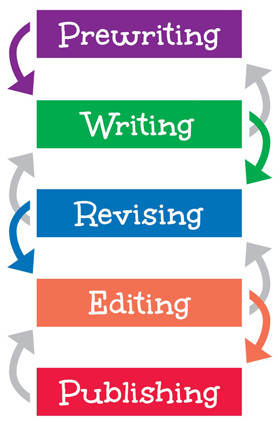
A lot of schools ask for a prompt and believe there is one specific road map in following to get you to the finish line. That’s not true. Inauthentic writing is something schools, specifically those of middle school and high school, need to break away from. Continuing the Journey also goes ahead and states, “when we move away from it [authentic writing] to the inauthentic kinds of recipe writing instruction we often give students–write an outline and then follow it; choose your topic sentence and then structure everything around it–we deny the reality of what any student or adult writer knows about how actual writing processes work” (Lindblom 17). Lindblom and Christenbury are correct. Embracing a messy process prepares students to write more effectively and doesn’t make them sound robotic.
After reading “Writing in the Work World,” I tend to agree with a lot of what David, Weller and Funderburgh had discussed. Once students exit high school, are they really “career ready?” All throughout high school, the main concern from every teacher and faculty board is to get students ready for standardized testing. Sure, you can have students memorize default answers, but how is that preparing them for the careers and fields that they’re about the enter? The fact of the matter is it isn’t preparing them for anything except how to be a test-taker.
The writing list people generated contains a wide variety of topics. Police reports, computer coding, and scientific notes are just a handful of many topics that had been discussed and thought about. Are high school students generating this list? Probably not. Giving students choice is a major key to gearing them up for success post-high school. If you want your students to leave high school on the cusp of being career-ready, they have to be trained to flexible in terms of what they write. That is the job of the teacher. The article even says, “we all agreed that standardized writing assessments would do little to prepare students for this range of writing” (David). Instead of teaching our students to be robots (purely memorizing), we need to introduce them to anything and everything so that they know what they want to pursue.
As an aspiring teacher, I’m a little concerned for the students in high school. Is there more writing flexibility now than when I was five or so years ago? If so, students are being trained before college the necessary career skills. If not, how can we expect them to be ready for these high-skill tasks in college? Expose them to a range of texts. Go over a sample police report, a scientific experiment table, heck even have them edit an email that was going to somebody’s boss. In order to be a successful writing teacher, one must be open to allowing your students the freedom to choose from anything that comes to mind. With this, you’re allowing them to be who they’re. We live in a time where knowing your students couldn’t be any more important. We need to learn their tendencies so that we can extract as much knowledge out of them as possible. Our attitudes have to be positive, and the idea of can’t or won’t is unacceptable as educators.
This is an example post, originally published as part of Blogging University. Enroll in one of our ten programs, and start your blog right.
You’re going to publish a post today. Don’t worry about how your blog looks. Don’t worry if you haven’t given it a name yet, or you’re feeling overwhelmed. Just click the “New Post” button, and tell us why you’re here.
Why do this?
The post can be short or long, a personal intro to your life or a bloggy mission statement, a manifesto for the future or a simple outline of your the types of things you hope to publish.
To help you get started, here are a few questions:
You’re not locked into any of this; one of the wonderful things about blogs is how they constantly evolve as we learn, grow, and interact with one another — but it’s good to know where and why you started, and articulating your goals may just give you a few other post ideas.
Can’t think how to get started? Just write the first thing that pops into your head. Anne Lamott, author of a book on writing we love, says that you need to give yourself permission to write a “crappy first draft”. Anne makes a great point — just start writing, and worry about editing it later.
When you’re ready to publish, give your post three to five tags that describe your blog’s focus — writing, photography, fiction, parenting, food, cars, movies, sports, whatever. These tags will help others who care about your topics find you in the Reader. Make sure one of the tags is “zerotohero,” so other new bloggers can find you, too.

 Writers Uncensored